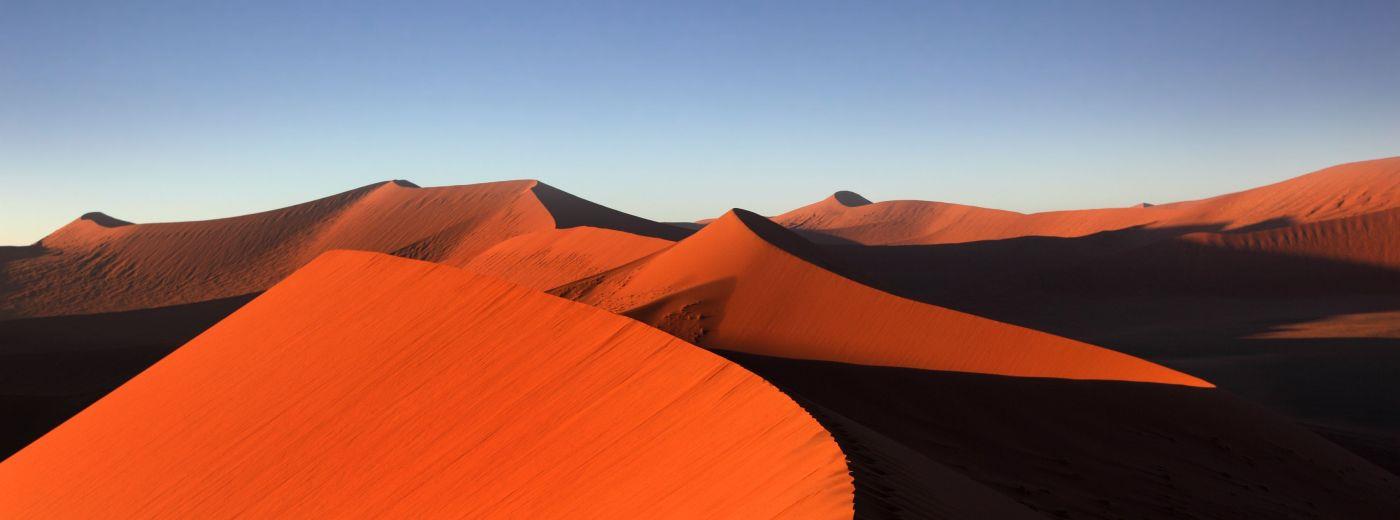
Snow … in Namibia ????
Wednesday, June 8th, 2011Yes, Namibia. Normally, the land of deserts. Or rather now, the land of Frosty the Snowman.
These pictures were taken yesterday.
I am not really sure there is anything else much to say !!!!


Yes, Namibia. Normally, the land of deserts. Or rather now, the land of Frosty the Snowman.
These pictures were taken yesterday.
I am not really sure there is anything else much to say !!!!


The wonderful Wolwedans Dune Camp, in Namibia’s Sossusvleu, has just announced that they have upgraded 6 of their tents (and I say tents with my tongue in my cheek – I should rather say palatial suites – they are stunning!).
The new tents are larger, with private bathrooms and a bigger deck area outside.
Wolwedans provides the perfect base from which to explore vast stretches of undisturbed nature. The personal and informative scenic drives in open Land Rovers reveal the wonders of the wilderness.
Scenic flights are another popular activity at Wolwedans. Commencing during the late afternoon, these flights give you a birds-eye view of the Diamond Coast and Sossusvlei and is a truly exhilarating and once-in-a-lifetime experience.
Another special attraction is hot-air ballooning. Soaring silently over the dune belts and never-ending plains provides unforgettable and breathtaking 360 degree vistas. From the best viewpoint imaginable, you admire the stark beauty of the Namib for about an hour, before celebrating this once in a lifetime experience with a champagne breakfast at the landing spot.
There is a minimum stay of 2 nights at the camp.
The second episode of ‘Cheetah Kingdom’ will be screened on ITV1 at 8pm this evening.
An ITV film crew has spent much of 2010 at Okonjima following the daily work of the AfriCat Foundation. The series provides a glimpse at the conservation work undertaken by the foundation and provides a great overview of life at Okonjima.
The series tracks the largest cheetah release programme attempted in Namibia, a country that is home to roughly a quarter of the world’s cheetah population, where they’re routinely trapped by farmers protecting their land. This episode follows the fortunes of the group of cheetahs being prepared for life in the wild and viewers get to see the next stage of their release as the gates are opened to their new 40,000 acre home.
If you missed the first episode or do not have access to UK TV you can catch up on the ITV Player site.
Zebras … everyone knows that they have black and white stripes.
But not any more.
Over the past few years in Namibia’s Etosha National Park, several plains zebra have been seen with mainly black skin and very few white stripes.
German tourist Peter Spätling – a geography teacher and amateur photographer – first noticed such a zebra in 2004, and over the following years, he identified 10 mainly black zebras.
So far there is no scientific explanation for the mutation of such a dark-coloured zebra, but one theory is that the cells responsible for the black colouring are defect and are producing too much black pigment.
This picture was taken recently by Italian tourist Martin de Massimo – if you also see one, please send us the photo and we would be delighted to add it to our blog.

We always say that a trip to Namibia is not only an adventure, but it is also offers some superb game viewing opportunites … for these guests travelling with Springbok Atlas, this was certainly true !
I wonder if the giraffe was just lost and asking for directions to the nearest waterhole though ?


Guests who choose to stay at Little Kulala, Kulala Desert Lodge and Kulala Wilderness Camp can now enjoy something completely different as an added activity – a camel ride !
3 rides are currently offered – a 10 minute ‘hop on / hop off’ ride literally for those people who want to say ‘been there / done it’ kind of thing; a short Photo Dune Ride and a longer Sundowner Ride.
On the Sundowner Ride, guests ride out to a designated spot, where a table with drinks and snacks have been set up, and after sunset the riders decide whether to go back to the camp on the camels or by vehicle. My only piece of advice … don’t have too many sundowner drinks if you choose the camel option !
Similar to the balloon rides, the camel activity is offered by an independent operator, Camels Namibia, based on the reserve.
To help support tourism in Namibia, the Namibia Tourist Board has got together a collection of lodges and Air Namibia, who for the months of June and July ONLY will be offering up to 50% off their published rates.
The collaboration is know as “Namibia: It’s Open Season” and its sole purpose is to help generate more visitors to this stunning counrty.
The Air Namibia participation in “Namibia: It’s Open Season” will apply to all major tourism routes of Frankfurt, Johannesburg and Cape Town.
Please contact us now for more information !
A new single entry visa is being piloted, in preparation for visitors coming over to South Africa for the World Cup.
This will mean that people wanting to travel to not just South Africa, but the neighbouring countries too (Mozambique, Zimbabwe, Namibia, Botswana and Swaziland) will only need one visa to cover all countries.
Mozambique is the first country who intend introducing the single visa, known as Univisa. The visa is primarily aimed at tourists from Europe and the United States.
This week has been witness to a remarkable milestone in the 16 year history of the AfriCat Foundation, with 1,000 big cats now rescued!
The sheer determination and unshakeable belief that has allowed the foundation staff to achieve this goal is staggering. Every single one of the rescues has meant a lengthy drive or light aircraft flight, careful liaison with the owner of the land or the community (at best curious and at worst plain hostile towards the predator) and then the laborious and dangerous task of extricating the cat to sanctuary.
In many cases, that is simply the beginning of a period of rehabilitation with the aim of releasing the cat back into the wild.
So who was lucky number 1,000? He was a 3 month old leopard cub rescued along with his mother (cat no. 999) from a farm in the Grootfontein area. Fortunately both mother and cub were in excellent health and were released together into the wild just 24 hours after their rescue.
The 1,000 cat statistic represents 650 cheetahs and 350 leopards. It does not include the scores of smaller predators that find themselves in need of AfriCat’s help. Every single one of these predators would have been destroyed were the AfriCat Foundation removed as an alternative option.
If you consider the fact that 86% of these cats are released back into the wild to continue the species, the impact AfriCat has on preserving Namibia’s predator population is quite amazing. The influence that AfriCat has on the awareness and tolerance for predators is impossible to quantify but just as significant long term in the survival of these species.
The AfriCat Foundation is able to operate because of private funding and the support of their single biggest donor, Okonjima, where guests can stay one (or ideally 2) nights at either Okonjima Main Camp or Bush Camp, and participate in the many activities on offer including the tracking on foot of the rehabilitated cheetahs on the Cheetah Tracking Trail, or radio-tracking leopards from an open game viewing vehicle in the 4,000 hectare rehabilitation area; bushman trails and walking trails; and a visit the Cheetah Project, an invaluable insight into the welfare work of the Foundation.
Namibian-based Sense of Africa have announced the launch of an open-top double decker bus tour of Windhoek.
Sense of Africa have also gone into partnership with a community-based operator in the Aabadi Bushman Village. Tours will be conducted to the village, fufilling a strong demand for cultural interaction by visitors.