October 12, 2012

New Wilderness Camp to be Opened in July 2013

Filed under: African Safari,Namibia,Travel News — Tags: , , , , , , — Tracey Campbell @ 2:46 pm

Wilderness Safaris have just announced that they will be opening their brand new Wilderness Classic camp – Hoanib Skeleton Coast – in July 2013.  This exclusive camp will have just 8 units (including one family unit) and will be located 90 km south-east of their previous Skeleton Coast Camp site, offering guests the opportunity to still visit this remote area of Namibia.  Daily flights will be into a dedicated new airfield in the vicinity, which has been designed to impact as little as possible on the fragile desert environment.

The new camp is located on the Hoanib River, on a private concession straddling the Palmwag area and Skeleton Coast National Park, in one of the most remote areas of the Kaokoveld.  The Kaokoveld is a land of beautiful rugged scenery, and the historic coastline, mountains, vast plains, and dry riverbeds are inhabited by plant and animal life who are fully adapted to the harsh desert conditions. Despite the arid environs, one of the greatest concentrations of desert elephant and lion can be found within this extraordinary area – along with sightings of giraffe, antelope, black rhino, leopard and cheetah.

Exploring the territory on foot, by vehicle, in hides, and by air, small groups led by expert safari guides can look forward to unravelling the enigmatic history of the original Strandlopers (“Beachcombers”), their stone circles lying in hidden valleys, marvelling at the ancient Welwitschia plant, following herds and other wildlife, and savouring endless coastlines and landscapes unfolding untouched for hundreds of kilometres.

For the first time, forays into the Hoanib floodplains (previously restricted inside the Skeleton Coast National Park) can be undertaken; this includes the strange upwelling of fresh water at a series of oases in the middle of the shifting Namib Desert. Extended journeys will explore the shores of the world-famous Skeleton Coast.

In line with Wilderness Safaris’ commitment to the Government of Namibia’s far-sighted Community-based Natural Resource Management policy – an approach that Wilderness has embraced from the outset – the twenty-year concession is a joint venture with the neighbouring Community-based Conservancies of Anabeb, Torra and Sesfontein.

We look forward to sending the first guests there in a few months time!
October 10, 2012

10 Reasons to go to Namibia

Filed under: Namibia — Tags: , , , , , , , , , , , , — Tracey Campbell @ 4:37 pm

A trip to Namibia is an adventure in itself. Namibia is a beautiful country, with endless highlights – the red sand dunes of Sossusvlei, the wild desert elephants in Damaraland, the stunning Etosha National Park … it is, however, a vast country, so it does involve a lot of driving – the average distance between destinations is 5 hours driving on gravel roads.

Windhoek – the capital of the country, and most visitors either begin or end their trip here for a couple of days, then head either northwards or southwards.

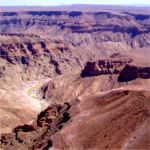
Fish River Canyon – situated between the Namib and Kalahari deserts, the only roads to it are across vast areas of flat and barren landscapes, sparsely populated with desert plants, quiver trees and cacti. As a result of this physical isolation, the whole place feels magical and unvisited, despite being a major tourist attraction. At 160 km in length, up to 27 km wide in places, and a depth reaching up to 550m, it is certainly hugely imposing and one of Southern Africa’s most stunning natural features.

Aus – there are approximately 170 wild horses living wild in the Namib Desert near Aus, and there are many theories as to how the horses came to be here. The most likely one is that they are the descendants of the horses which were left behind when the German troops fled the area in 1915.  The number fluctuates depending on the grazing conditions. After the rains, tiny green shoots sprout up through the desert floor, providing nourishment for the horses to help sustain them during the next long dry period.

Kolmanskop – Namibia’s most visited ghost town lies 10 km inland from Lüderitz. Once a bustling boom town built on the success of the diamond mining, now it is deserted except for the sand which is slowly engulfing the houses and buildings.  It is truly a photographer’s dream.

Sossusvlei – one of the oldest deserts in the world, and most famous for its huge red sand dunes, which are the most popular and visited tourist attraction in Namibia. The contrast between the clear blue skies, deep red dunes, and the cracked white base of the dry lakes (vleis) lends itself to some truly stunning photography, and climbing the easily accessible dunes to get a view over the spectacular ‘dune sea’ is unforgettable.

Swakopmund -Namibia’s busiest coastal resort town and offers a range of activities including quad biking, scenic flights and sandboarding.

Damaraland – track desert elephants and rhinos, visit Twyfelfontein (now a World Heritage Site), or just enjoy the harsh beauty and ruggedness of north western Namibia.

The Skeleton Coast – a fascinating area, but difficult to reach. You could drive yourself up along the coast or inland, but only limited operators can actually access the Park itself. Trips up here would be either done by fly-in, or overland safari, and can be very expensive, but worth every penny!

Etosha National Park – offering some of the finest wildlife viewing in Africa, and one of the undisputed highlights of any visit to the country. The Park is home to 114 different mammal species, including 4 of the Big 5 – leopard, lion, elephant and rhino (both black and white). The Park has recorded nearly 400 species of bird, and over 110 species of reptile, and is also home to 3 uncommon antelope species – the beautiful black-faced impala, the roan antelope, and Southern Africa’s smallest antelope, the Damara dik-dik, which stands only 40cm to the shoulder as a fully grown male adult.

AfriCat Foundation – a non-profit organisation which aims for the long term conservation of large carnivores in Namibia. They rescue, relocate and even rehabilitate problem big cats, and try to raise awareness of the issues involved. Guests can become involved in the project, as some of the activities offered at Okonjima include leopard and cheetah tracking on foot.

October 4, 2012

5 Reasons to visit Hazyview in Mpumalanga

Filed under: African Safari,Family Holidays,South Africa — Tags: , , , , , , , , , , , , , , , — Tracey Campbell @ 10:00 am

Not many people really consider Hazyview as a key holiday destination, but we think that should change!  Why?  Well, here are our Top 5 reasons why anyone should include a night or two here.

The Kruger National Park – need I say any more?  Hazyview is a mere 15 minute drive from the Phalabeni Gate into the Park, or about an hour tops to the main Paul Kruger Gate, so ideally placed for a day visit on a self-drive safari in this famous Park.

The Kruger National Park is the premier self-drive safari destination in South Africa, with an unbeatable variety of wildlife and habitats to explore, an excellent infrastructure of roads and accommodation, and a feeling of huge, wide-open spaces.  Self-drive in Kruger is a wonderful experience – the thrill of driving along a road by yourself and coming across a pride of lions basking under a nearby tree, or waiting at a peaceful waterhole and having a sighting all to yourself is hard to beat.  Inside the Park, there is an excellent infrastructure of roads, some of which are tarred, others gravel. Good, clear signposts help to make the driving experience easy and enjoyable.

Panarama Route – the highly promoted ‘Panorama Route‘ is a self-drive route, which can be done from Hazyview in a day, and this route takes in many of the scenic sights, which include:

The Blyde River Canyon – estimated to be 60 million years old, and is over 25 km long and up to 800m wide in places. The Reserve is a spectacularly beautiful area, with many waterfalls, lush forest areas, and fascinating geological formations sculptured by years of erosion.

Bourke’s Luck Potholes – spectacular smooth sided cylindrical potholes have been carved naturally into the rock bed of the river, some of which are 30m (100ft) deep.

The Three Rondavels – an impressive and much-photographed rock formation, which rise out of the canyon.

God’s Window – offering stunning panoramic views over the Lowveld as far as the Kruger National Park.

The traditional villages of Shangana – home to families who invite guests to experience their culture and way of life.

Moholoholo Wildlife Rehabilitation Centrea sanctuary for injured, abandoned and poisoned birds and other wildlife, and a must for anyone interested in raptors and birds of prey.  Wildlife is brought to the centre from all corners of South Africa, and once healthy enough are re-introduced into their natural environments.  Animals who cannot be returned to the wild for any reason are cared for at the centre.

Hoedspruit Endangered Species Foundationthis is a unique project that conducts essential research on endangered species, and provides visitors with the opportunity to view animals, such as wild dog and cheetah, that have found a home here within natural surroundings.  The tours are an educational experience, but as well also emphasise the important role that everyone has to play in the conservation of South Africa’s wildlife.

And finally, you need a place to stay, so our recommendation is Rissington Inn – a great guest house, that we have worked with now since we very first started Travel Butlers.   Just on the outskirts of Hazyview, Rissington is the perfect place to base yourself to explore the area.

October 2, 2012

A Mothers Love and Devotion

Filed under: African Safari,South Africa,Travel Butlers — Tags: , , , , , , , — Tracey Campbell @ 11:00 am

A few years ago, I was on safari in Sabi Sands, staying at Savanna Private Game Reserve.

On the way back to the lodge one early evening, we saw a herd of about 40 buffalo, with several young.  2 minutes later, we caught sight of the pride of lions, sitting up in the long grass, with their eyes fixed on the herd.  Downwind of the buffalo, the herd had no idea of the impending danger.

Our ranger took the decision that the lion were not going to make any moves, not until it was completely dark.  We all returned to the lodge for dinner, but immediately after dinner, the offer was put to the guest ‘Who wants to go out again to watch the impending chase and kill?’

I couldn’t understand why it was just myself and my husband who jumped at the chance, I think maybe the phrase ‘kill’ put the other guests off.

2 Land Rovers set off about 10 pm – myself, my husband Paul and our ranger Andrew in one, and the other ranger Ryan in the other.  We went back to where we had last seen the lion, and true to expectations, they had moved closer to the herd.

We parked up behind the lion pride, watching and waiting, for about an hour.  There were 8 lionesses in total, and they alternated between sitting up alertly, and lying down looking completely uninterested.

Then we had movement.  The buffalo herd became a bit dispersed, and a female and her calf were left slightly isolated from the rest of the herd.  As one, the lion pride started to move, half going around one way, half going around the other.  The calf wobbled on its legs, close to its mother, totally unaware of the danger that was about to erupt.

And erupt it did.  The lionesses moved as one, and within seconds, the mother had fled in one direction, and her calf had been brought down.  I covered my eyes, I know it is nature, but I didn’t want to see it come to its final end.

But then the mother returned.  Head down, she charged at the two lionesses who were holding the calf down with their paws.  They leapt away, and the mother turned and charged at another lion.  Confused, the lions began to scatter, and temporarily forgot the calf.  I was convinced that the calf was actually dead, then we saw it move, and it struggled to its feet.  It had survived its ordeal.

The mother continued to run at every lioness she could see, but just as I began to fear that she also would be pulled down, the cavalry arrived in the form of the remaining herd members.  Suddenly, the plain in front of us was full of buffalo running at lions.  Lions jumped on buffalo backs, buffalos kicked back and lions went flying.  One lion tried to climb up a tree, only to have to leap out of the way of a glancing buffalo horn.  The buffalo were on a mission, to protect their own.

Realising defeat, the lionesses decided to beat a hasty retreat.  The buffalo gave chase one final time.

Then it dawned on us … we had 8 lionesses running straight towards US at full pelt, with 40 angry buffalo hot on their heels (or paws).   We had been so enraptured by everything, we completely forgot that we should really be moving too.  Too late … now we were the ones being chased.

I never appreciated just how fast Land Rovers could go in reverse. I don’t know if anyone remembers the old Benny Hill sketches … well, this was very similar.   Land Rover being chased by lions being chased by buffalo.

The next day, we found the buffalo again.  The calf was easy to spot, as it had huge welts down its side from where it had been pulled down, but it seemed to be OK.  How long it did survive for, I don’t know, I like to think that it lived a long and happy life.

Funnily enough, about 5 years later, we bumped into our ranger Andrew, at another lodge.  He looked at us, recognition dawned, and the first thing he said?  ‘Hey, weren’t you the guys that we watched the buffalo lion chase with’?  He admitted that in all his years of being a ranger, this was one of the best nights of his life.  And it was definately one of my all time best safari memories.

September 28, 2012

Congratulations to Cape Town – Best Beach Destination

Filed under: Cape Town,South Africa,Travel News — Tags: , , , , , , — Tracey Campbell @ 11:44 am

In last week’s annual World Travel Awards, Cape Town stormed to victory, and took the Best Beach Destination award.

Cape Town was against stiff competition from the likes of Bazaruto in Mozambique, Diani Beach in Kenya, the Garden Route’s Plettenberg Bay,  and Zanzibar in Tanzania, not forgetting the previous winner, Sharm El Sheikh in Egypt.

Says Grant Pascoe, Mayoral Committee Member for Tourism, Events and Marketing: “Cape Town’s beaches are a huge tourism asset, particularly because they are so diverse. We have family beaches, tidal pools, clear water, challenging surf, endless beaches, tranquil coves – and more. Our beaches are a place for relaxation, exercise, discovery, and inspiration and so appeal to a wide range of travellers and can offer so much in a single visit.”

Other South African winners at the 19th World Travel Awards included SAA for Best Airline, 1Time for Africa’s Leading Low Cost Airline, Ellerman House & Villa (“Africa’s Leading Luxury Villa”), Saxon Boutique Hotel, Villas & Spa (“Africa’s Leading Luxury Hotel”), The Blue Train (“Africa’s Leading Luxury Train”), Fairmont Zimbali (“Africa’s Leading Tourism Development Project”), and Shamwari Game Reserve (“Africa’s Leading Safari Lodge”).

Congratulations to all the winners!

Six of The Best…A Safari in South Africa’s Eastern Cape Region

Filed under: South Africa — Tags: , , , , , , , , — Paul Campbell @ 11:00 am

The Eastern Cape region is one of the most popular safari holiday destinations in South Africa. The main reason it is such a perennial favourite is that it enables visitors to combine an outstanding safari experience with a trip to one of Africa’s most vibrant and exciting cities – Cape Town.

You will find that you are spoilt for choice when it comes to choosing a safari in the Eastern Cape region, as the area boasts a number of private game reserves, not to mention the Addo Elephant National Park.   Of these, perhaps the most popular are:

Kwandwe Game Reserve

This large private game reserve, about a 2 hour drive from Port Elizabeth,  provides visitors with 4 outstanding lodge accommodation options. The numerous lion, cheetah, rhino, elephant, hippo and leopard which call Kwandwe home can be observed by way of both day and night drives. In addition, the reserve also offers bush walks to visitors of all ages (although children need to be over the age of 12 to join a bush walk, and over 6 to join their parents on a game drive).

Addo National Park

It is fair to say that Addo is a National Park which really does offer it all. Indeed, it is not every African safari destination which can offer you the chance to see whales and great white sharks as well as the ‘Big Five’ safari animals. Situated just north of Port Elizabeth, Addo has a number of luxury guest houses just outside the main entrance, as well as more budget conscious chalets and rondavels which are located in the Park itself at the Addo Main Rest Camp. In addition to safari drives, Addo also offers horse riding.

Shamwari Game Reserve

Shamwari is a private game reserve which offers visitors a chance to see the Big Five in 25,000 hectares of beautiful African bush. The lodges offered here are very luxurious and all game drives and meals come included with the package.

As well as enjoying daily game drives and bush walks, you can also chill out around the sparking swimming pools at each lodge.

Amakhala Game Reserve

If you are looking for bountiful animal sightings then Amakhala is just the job. Indeed, this family-owned game reserve boasts lion, elephant, rhino, buffalo, cheetah, giraffe, zebra and antelope so you can be sure that you won’t go home disappointed. Located just east of Port Elizabeth, Amakhala not only offers game drives and a variety of very comfortable lodges, it also extends day visit privileges to anyone who does not have the time to stay for a night.

Kariega Game Reserve

The Kariega Game Reserve offers abundant wildlife, river cruises, walking trails and plenty more besides.

The lodges here offer a variety of accommodation options, including luxury riverside chalets and the 5 bedroomed Homestead, which can be booked on a private basis, making it perfect for friends or families travelling together.

Pumba Game Reserve

In the heart of the Eastern Cape’s malaria-free game viewing region you will find Pumba Private Game Reserve, situated a mere 105 km from Port Elizabeth.  The reserve stretches over an area of 6,000 hectares. Home to the Big 5, the reserve offers visitors the chance to experience the wonders of Africa – from the graceful giraffe to the white lion.

Explore our Eastern Cape Safari pages further or call 0845 8382450 to find out more.

September 25, 2012

Cape Town and Garden Route Escorted Tour in October from just £1,015 per person

Filed under: African Safari,Cape Town,South Africa — Tags: , , , , , , , , , , , , , , , , , , — Tracey Campbell @ 5:15 pm

If you are looking for a last minute inspiration to get away for a week, take a look at this 6 night/7 day tour that we are offering.  With only a few places left, now is the time to ask us to book your place on this escorted trip, which starts in Cape Town and ends in Port Elizabeth.  With a price of just £1,015 per person (excluding international flights), we are sure that these places will go very very soon!

Read more about the trip here:  6 Night/7 Day Tour

Summary of the trip

You begin with 2 nights in Cape Town, and as well as dinner the first night with fellow guests, you also get a half day City Orientation tour and a full day Cape Peninsula tour as well, so you can really see why people fall in love with this beautiful city.

Leaving Cape Town behind on Day 3, you travel via the Winelands (where you get to taste some wine and enjoy a cellar tour) to Hermanus, the whale watching ‘capital’ of the Western Cape.  During October, daily sightings of the majestic Southern Right Whales are the norm, and the many paths along the Hermanus clifftops offer a fantastic viewing point to watch the whales breaching out in the ocean.

Oudtshoorn is next on your agenda, including a guided Ostrich Farm tour and a visit to the stunning Cango Caves, which  are illuminated to show some of the biggest stalagmite formations in the world.

A trip along the Garden Route would not be complete without a night in Knysna (pronounced Ni-sna), a popular town with a vibrant Waterfront area.

Your last night is spent in Tsitsikamma, the ‘place of much water’, before you head to Port Elizabeth, where your escorted trip will end.

For those with more time on their hands, there is of course the option to add on a few nights on safari in one of the malaria-free Big 5 game reserves here, which are about an hours drive from Port Elizabeth.  Just ask us to include this for you in our quote.

September 24, 2012

Thanda Continues to Support World Rhino Day

Filed under: African Safari,South Africa,Travel News — Tags: , , , , , — Tracey Campbell @ 9:47 am

We are proud to work with the likes of Thanda Private Game Reserve, who are situated approximately 300 km north of Durban.

This Big 5 reserve  has played an active role for many years in rhino conservation initiatives, and are totally supporting World Rhino Day, which was held on Saturday to promote the cause worldwide of the current dire situation of the rhino due to illegal poaching activites, which is seeing hundreds of rhinos being mercilessly slaughtered for their horns.

For all bookings made from September to December 2012, the reserve are giving a portion of the money to Project Rhino, so your booking at Thanda can make a difference to this worthwhile cause. Project Rhino is an association of like-minded organisations allowing collective co-ordination of rhino conservation interventions, which are aimed at eliminating rhino poaching and securing the rhino population in KwaZulu-Natal.

To also raise awareness of the plight of the rhinos to their guests, Thanda will also be serving a signature dish once a week in honour of the rhino.  And if this isn’t enough, guests staying here will be given an opportunity to get up close to and experience first-hand the majestic and endangered rhino, through an interactive experience that will be available to guests at a additional cost of R800 per person. Guest will be taken out with a qualified guide who will track the rhino by means of telemetry or in layman’s terms; “rhinoing”.

Thanda also work alongside Wildlands Conservation Trust, Ezemvelo KZN Wildlife, Wildlife ACT, Space For Elephants and African Conservation Trust, who together have spearheaded many initiatives for rhino conservation.

September 19, 2012

Top 5 Things to Do In Cape Town

Filed under: Cape Town,South Africa — Tags: , , , , , , , , , , , — Tracey Campbell @ 10:00 am

Table Mountain

If the weather is beautiful – go up Table Mountain immediately!  This really is one of the main highlights of Cape Town, and even if it is a beautiful morning sometimes in the afternoon a cloud can descend on the top of the mountain – it looks like a white tablecloth laying over the top of the mountain – and visibility is practically zero!

If you drive up there, you will probably have to park on the road and walk up to the cable car, and normally there will be a guy directing you into a space.  He will probably hand you a card or a slip of paper and it is customary to tip him when you return – the ‘going’ rate is about R5 – R8 per hour.

There is a small restaurant at the top of the mountain and a bar, but one idea is to ask the guest house to pack you up a lunch, and find a quiet spot with a view on the top of the mountain to enjoy it.

City Bus Tour

A city tour on an open top bus this afternoon is a good way to orientate yourself to the City.  The buses are known as Topless Busses, and can be caught at the back of the Clock Tower Precinct at the V&A Waterfront. They work on the ‘hop-on, hop-off’ system, and the tour lasts about 2 hours if you stay on the bus the whole time.

Cape Peninsula and Boulders Beach

A day trip down to the Cape Peninsula is a must.  Our recommended route is to set off towards Simon’s Town (the guest house will be able to give you directions), and stop at Boulders Beach on the way to visit the penguin colony there.

There are 2 main attractions here: the main viewing platforms allow you get right into the middle of the breeding colony where you can observe and photograph the penguins at close quarters (there are literally hundreds of penguins here); the second beach is smaller and lesser known, but you can actually get onto the sand and into the sea here and there are usually a few dozen penguins mixing with the bathers.  The second beach is to the right of the ticket booth right by the main car park.

From Simon’s Town you would then drive down to Cape Point, situated in the Good Hope Nature Reserve.  You can either walk up to the lighthouse, or take the tram – either way, its wonderfully scenic. There is a restaurant here where you can have lunch, or you could bring a packed lunch and have a picnic on one of the many beaches.

On the way back, we would recommend driving via Hout Bay and Chapmans Peak drive – a truly stunning coastal road (when it is open – do check first!).

Township Tour and Robben Island

We would certainly recommend a half-day township tour.  Some people have doubts as to whether to go on a township tour, as it seems almost indecent to treat these areas as a ‘tourist attraction’.  However, with a good tour operator it is a memorable and enlightening experience.

Also, a boat trip to Robben Island, where Nelson Mandela was imprisoned, will round off the experience – be prepared to be moved to tears though as your guide is likely to be a former political prisoner and their stories are compelling.  This can be booked from the V&A Waterfront.

Bloubergstrand Beach

If you have time, a trip out to Bloubergstrand Beach to get the classic ‘postcard’ shot of Table Mountain over the bay is worthwhile – but be warned it is incredibly windy (hence why there are so many kite surfers there!).

September 17, 2012

The Wrong Use of a Foghorn

Filed under: African Safari,Namibia — Tags: , , , , , — Tracey Campbell @ 4:00 pm

A few years ago, we stayed the night at Ongava Tented Camp, which borders the fabulous Etosha National Park in Namibia.  When we checked in, we were shown around our room, and special care was taken to point out the foghorn.  We were told that as there was no cell/mobile phone reception, neither was there a telephone in the room, and the camp was  unfenced, the foghorn was our only way of communicating with the outside world after we were walked back to our tent at night, should there be any problems.

After dinner that evening, whilst relaxing with my drink around the open fire, I wondered out loud about how often the foghorn actually has been used.  Our ranger then held court for the next 15 minutes, while he told this story of a guest who had stayed recently in the camp.

The guest in question was a middle-aged American lady, travelling on her own.  She was spending just one night at Ongava, as she was doing a whirlwind tour of Namibia, so taking in all the sights in about 7 days, flying from destination to destination.  To say she was not an experienced safari-goer would probably have been a gross overstatement.

Anyway, after a very successful evening game drive, and a lovely dinner at the lodge, the lady was walked back to her tent by her ranger, who bid her goodnight.  The camp was full that night, and gradually all the other guests also retired to their rooms.   The ranger, his job done for the night, also disappeared, looking forward to a well-deserved nights sleep.

At around midnight, however, the entire camp was woken by the sound of a foghorn going off.  BWAAAAAAH BWAAAAAAH BWAAAAAAH it went, shattering the peace of the bush.

Leaping to his feet, the ranger grabbed his gun, and set off in hot pursuit towards where the noise was coming from, wondering what on earth he was going to find outside (or heaven forbid even inside) the tent.   Had a lion managed to open the tent zipper, and was now curled up on a guest’s bed?  Had a curious elephant accidently stumbled and fallen on top of the tent, and landed on the foghorn, setting it off?

The noise was coming from Tent 8, the tent that was the home to the American lady.  The ranger slowed down, and took a look around with his torch.  No new paw prints, no eyes reflecting in the beam, in fact, nothing looked out of place.  The only thing out of place was the sound of the foghorn, which was still being blasted out into the night.

The ranger hammered on the tent opening, and the zipper came up.  The lady stood facing him, dressed in pyjamas and a dressing gown, and holding the foghorn.

‘What’s wrong’, demanded the ranger in sheer panic, trying to look round her into the tent to see what on earth could be happening.

‘Ah gee,’ said the lady, ‘Sooo pleased to see you.  I’ve got a real craving for some ice-cream, can I have a bowl please?  If you have any chocolate, that would be great, otherwise just vanilla would be fine…’

Needless to say, the lady did NOT get any ice-cream brought on a silver tray to her tent…

« Older PostsNewer Posts »