
A Journey across South Africa

Rovos Rail, Entabeni Safari Conservancy, Cape Town and Johannesburg.
8 day itinerary.
Prices from US$ 2,962 pp*

Despite its colourful reputation, Johannesburg has a wealth of attractions, and the vast majority of overseas visitors leave pleasantly surprised, especially if it is their first time to the city and they have had the time to explore it for a couple of days.
Despite its colourful reputation, Johannesburg, in the Gauteng Province (pronounced "How-Teng"), has a wealth of attractions from museums to amusement parks, and some of the best accommodation, restaurants and shops on the continent.
Whilst it is impossible to ignore the problems that the city has had in recent times, much has been done to improve the situation.
Although it is fair to say that Johannesburg will not be the overwhelming highlight of your trip to South Africa, if you find it makes sense to include Johannesburg for a night or 2 within your itinerary, then we would definately say don't dismiss the idea completely. The vast majority of overseas visitors who do take the time to explore Jo'burg properly leave pleasantly surprised, especially if it is their first time to the city.
The majority of visitors to Johannesburg who are visiting the city for 2 or more nights stay in one of the many wealthy and exclusive northern suburbs of the city, as some of the best accommodation options are found here.
Sandton is the main hub of this area, and is easily accessible from Johannesburg OR Tambo International Airport - especially since the opening of the Gautrain, which is South Africa's first world-class, modern rapid rail service - it takes just 15 minutes from the airport direct to Sandton. Sandton also boasts excellent shopping malls and restaurants.
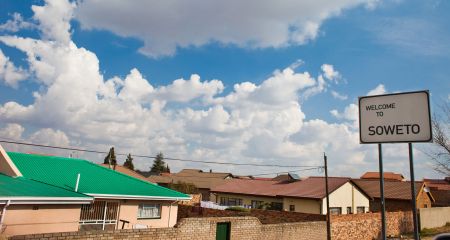
Soweto is to the south-west of the city centre, and is best known for the part that it played in the anti-apartheid movement. Today, it is a growing city in its own right, with affluent middle-class areas as well as poorer districts, and is home to over 3 million people - 1 million of whom commute daily into Jo'burg city centre to work.
Soweto was established in 1944 when the black population was moved out of the white-only areas under apartheid. In the 1950s, Soweto expanded massively, and the area soon became a city in its own right. The city has over 260 primary schools, 70 high schools, 1 university, 1 teacher training college, 300 churches, 18 state clinics, 15 police stations, 14 railway stations, 7 libraries, 12 community halls and 120 soccer pitches. The hospital is the largest in the world, with 3,200 beds and 7,500 staff.
As with any township in South Africa, we strongly advise against going into Soweto without a local guide to show you around.
One of the highlights of a trip to Soweto is a visit to Nelson Mandela's former house, where he used to lived before his prison sentence. He returned to the house briefly after his release from Robben Island.
In the house are many personal pictures and effects, as well as certificates and diplomas given to Mandela by various institutes in recognition of his achievements. There is even the world middleweight championship belt which was given to Nelson Mandela as a gift by Sugar Ray Leonard.
Nelson Mandela stayed in this house after his release for only 11 days, however, as his much longed-for privacy was being constantly invaded by well-wishers and supporters. He moved into a nearby house that had been built by his wife, Winnie, during his confinement.
During the 1970s and 1980s, Soweto was a leading force in the struggle against apartheid, and became infamous for the violent clashes with police, pictures of which were broadcast on television and reported in newspapers worldwide.
In particular, many people will remember the June 1976 student march, where over 2,000 students staged a peaceful protest against the use of using Afrikaans as the official language in the classroom. The peaceful protest soon turned violent, as police fired with tear gas and bullets, and many students, including schoolchildren, were killed or injured.
13 year old Hector Pieterson was one of the first students to be killed in the shooting, and his memory lives on in the Hector Pieterson Memorial and Museum. The museum was run by his sister, Antoinette, who was famously pictured running next to her brother's dead body as he was being carried away from the riot scene.
For the adrenelin seekers, Gold Reef City is a must. There are around 30 rides in this amusement park, including some terrifying white-knuckle rides such as the Anaconda (the only inverted roller coaster in the world), the Jozi Express (a high-speed roller coaster) and the Tower of Terror (also known as the Shaft of Terror).
Gold Reef City is created around an authentic 19th Century gold mine, and an interesting half hour tour will take you 220 m (720 ft) below the surface, using the original mine lifts.
Johannesburg has a wealth of museums and galleries and other attractions to appeal to a wide range of interests.
The Museum Africa is a must for anyone interested in the history and culture of South Africa. The Johannesburg Art Gallery is an impressive looking building, right in the heart of the city, and is one of the very few art galleries which allows photos to be taken, albeit it without a flash.
The highly recommended Apartheid Museum tells the story of the rise and fall of apartheid. It starts from its roots in the battles between the British, Boers and native inhabitants in the 19th and early 20th centuries, through to the struggle for freedom and first all-inclusive elections in 1994. The museum successfully combines film, news reels and personal recollections to tell the story from a number of different perspectives, and the whole experience highlights just how far the country has come since those dark years.
The South African National Museum of Military History is one of Johannesburg's most popular museums, and from the quality and number of exhibits, it is easy to see why. As the name suggests, the Museum is dedicated to the military history of South Africa throughout both World Wars. You don't have to be a military fanatic to enjoy the exhibits and displays, which include fighter aircraft (the main attraction being an Me 262 2-seater jet fighter - the only one remaining in the world), tanks and guns, uniforms, medals, and a German one-man submarine. Outside, there is a special area for children, where they are allowed to climb over a selection of the tanks and guns. Unfortunately, you have to be under a certain age to do this - and we are sure many fathers were watching their children enviously.
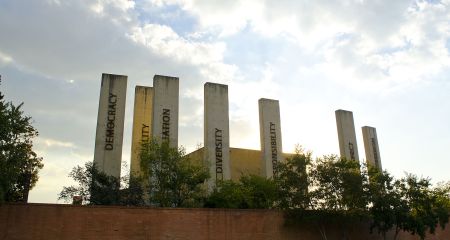
Constitution Hill is the former fort and gaol where common criminals and murderers were held alongside political activists such as Nelson Mandela, Mahatma Ghandi and the children who threw stones in the 1976 Soweto uprising. Built in 1898 originally as a fortress, it was later converted to a gaol. Today, it has been developed and is now a prime tourist attraction, housing the Constitutional Court. The old prison cells have been converted into an interactive museum, and a state-of-the-art audiovisual system shows footage of former prisoners recounting their experiences in the jails.
The Carlton Centre, or Top of Africa as it is more commonly known, is the tallest building not only in South Africa, but in the entire Southern Hemisphere. Standing 220m above street level, and 50 floors high, it is also the highest concrete structure in the world. Although not the most attractive of buildings, the view from the 50th floor is amazing. A lift takes you up there in 40 seconds (hold onto your stomach on the way down), and an enclosed viewing area at the top affords 360 degree views around the city.
The Mai Mai Centre is Johannesburg's traditional medicine market, and is situated under, of all places, a flyover. Mai Mai Medicine Market Upon first approaching the market, you may wonder where on earth your guide is taking you. Vendors line each side of the road, with their traditional remedies set out on the floor. Medicines include tree barks, roots, seeds, herbs, animal skeletons and bones, and whole heads (snake and monkey seem very popular). Whether the medicines work is up to the individual - if you believe in them, then they may work for you.
The World of Beer is an interesting place to spend a couple of hours, especially over the lunch-time period. A 90 minute tour in a small group of up to 15 includes the history of beer, how hops are grown, walk-through models of a turn of the century Jo'burg pub and a Soweto shabeen, and a full-scale brew-house showing the different brewing processes.
The Lesedi Cultural Village, about a 45 minute drive from Sandton, offers a great opportunity to see a wide range of different African dances, customs and dress, all in one place.
Lesedi - a seSotho word meaning 'light - features 5 traditional homesteads, each representing a different culture: Pedi, Zulu, Xhosa, Basotho and Ndebele.
It is interesting and well-done, however be warned - it is a purpose-built tourist attraction. If you are the type of person who is embarrassed by 'gimmicks' and 'shows', then this really is not for you.
There are 2 shows daily - midday and evening. The evening performance is particularly atmospheric, and best done as part of an organised tour.
Hotel
Guest Rating: 3.4
All of the 151 luxury rooms have en-suite bathrooms with bath and separate shower, hairdryers, colour television with Mnet, hairdryers, direct-dialling telephones, digital safes and tea/coffee making facilities. Rooms are fully air-conditioned for cooling comfort in the summer heat.
Hotel
Guest Rating: 3.0
Feel at home in the spacious 253 en-suite hotel rooms, which offer you all the modern comforts of your own home and more, including individually air-conditioned rooms, tea/coffee making facilities, satellite TV and wireless internet connectivity. There is also a swimming pool for guests enjoyment.