

Some of the finest wildlife viewing in Africa
Etosha National Park is an exceptional destination, renowned for offering some of the finest wildlife viewing opportunities globally. Located in northern Namibia, this expansive park covers 22,000 square kilometers of pristine landscape, making it an ideal choice for an unforgettable safari experience.
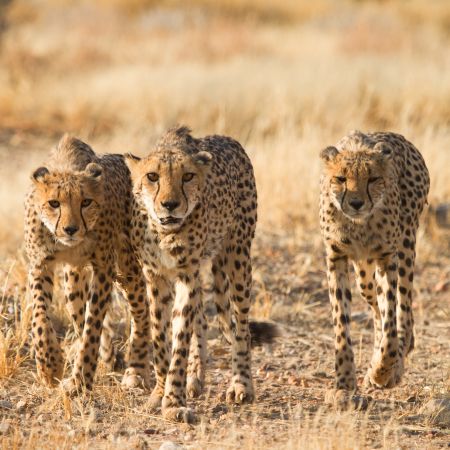
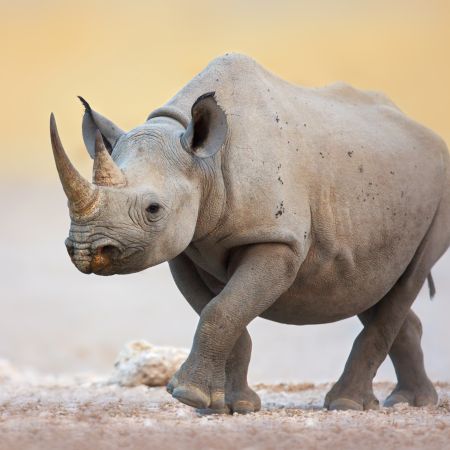
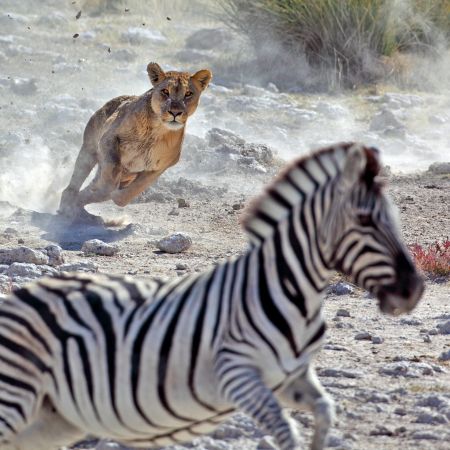 Etosha is home to 114 different species of mammal, including four of the famous Big Five - lion, leopard, elephant and rhino (both black and white). It also boasts over 400 species of bird and 110 species of reptile. You’ll also find 3 rare antelope species amongst its hills and valleys - the lovely black-faced impala, the graceful roan antelope and the dinky Damara dik-dik, Southern Africa’s tiniest antelope, which stands only 40cm tall to the shoulder as a fully grown adult.
Etosha’s strange but beautiful centrepiece is the vast Etosha Salt Pan, which constitutes 20% of the Park's total area and covers 5,000 square kilometres. This salt pan, which measures an amazing 130 km long and 72 km wide, is the habitat for an impressive diversity of wildlife, including large herds of zebra, giraffe and elephant that traverse its distinctive white surface and surrounding savannah.
Over 12 million years ago, the pan was a shallow lake fed by the trickles of the Kunene River, but shifting tectonic movement in the earth’s crust has since changed the course of the river, drying up the pan.
The San bushmen tell a story that the pan was formed by a young woman whose only child was murdered by savage hunters. The woman literally cried a river and her tears gathered into a great lake. When the sun shone upon the land, it dried up the water but left the ground sprinkled with salt.
The pan has a extraordinarily high alkaline content, which attracts a whole host of wildlife needing salt for nutrition. During exceptionally heavy rainfall, the Pan transforms into salty sludge lake and becomes the feeding ground literally thousands of wading birds and huge flocks of bright pink flamingos.
Vegetation in Etosha
The vegetation in Etosha varies mostly between bushland, long grass and sun-scorched savannah. It’s also dotted with Moringa trees, which look as if they have been planted upside down with their roots where their leaves should be and viva versa.
Legend has it that these striking trees were caused by the Creator, who became angry with the animals and furiously flung a tree down to Earth. Luckily, the tree missed the animals, but it landed topsy-turvy, where it stayed as a warning for the wildlife not to enrage the Creator again.
Exploring Etosha on a Self-Drive Safari
Many visitors to Etosha set off on self-drive safaris through the Park. From behind your own wheel, you’ll come across vast herds, pass the dazzling white pan, scour the savannah for wildlife and soak up the scenery.
 There are 4 main gates that lead into the Park - the Andersson Gate to the south, the Von Lindequist Gate to the east, the Galton Gate to the south-west, and the King Nehale Lya Mpingana Gate in the north. These gates are open from sunrise to sunset and upon arrival every visitor pays an entrance fee which contributes to the upkeep and the conservation efforts of Etosha. When you visit Etosha, you can either opt to stay in one of the comfortable lodges just outside the gates and drive in each day or stay at one of the rest camps within the boundaries of the Park run by Namibia Wildlife Resorts.
The main roads leading from the main gates are tarred, but after that you’re on gravel roads where the condition of the roads ranges from surprisingly smooth to badly pot-holed. The speed limit through the Park is 60 km and it’s really important to observe this at all times. Only the southern rim of the Etosha Pan is open to visitors and there are no roads traversing the Pan itself, keeping the landscape pristine and serene.
Strictly speaking, you don’t need a 4WD to explore Etosha. However, a high clearance vehicle with sturdy suspension is a very sensible idea, as it improves visibility (for looking over the bushes and through the long grass) and ground clearance (for puddles and potholes). All of the roads within Etosha are accessible by 2WD saloon car, but if you take one of these vehicles you need to be extra vigilant in wet weather. If you drive through too much deep water, you’ll risk soaking the spark plugs and the engine, and you really don’t want to breakdown next to a pride of lions - trust us!
If you are unlucky enough to break down or puncture a tyre, stay inside your car until help arrives. Do not get out. This kind of incident is highly unlikely, but make sure you have a mobile phone and plenty of water handy - just in case!
When to Visit Etosha
The best time to visit Etosha for a superb safari experience is from June through to October. These months start warm and get progressively hotter as you go through the year, and the vegetation dries out, making it easier to spot the wildlife. Because these are the dry months in terms of rainfall, the game is concentrated more around water holes as other water sources dry up.
The summer rains begin in November, and the dried out bush begins to take on a lovely green hue, but the water levels are just enhanced and if anything the excellence of the game viewing intensifies over November and December.
Come January and February, however, which are the wettest months, the wildlife is able to disperse across the Park more, as water is more abundant. Over these months, however, the Pan fills with water, attracting migratory birdlife and hundreds of flamingos.
Staying in a Private Reserve
We recommend staying in Etosha for a minimum of 3 nights. It’s a long journey to reach the Park, so it would be a shame to cut your visit short after the effort of getting there and there’s so much to see that even 3 nights is only barely enough. The ideal scenario is to stay near one gate for a couple of nights and then self-drive through Etosha to the other gate for a further night or 2. This will give you a good look at both sides of the salt pan without doubling back on yourself and provide a sensational safari at the very same time.
 Self-driving isn’t for everyone, so if you’re not excited by the prospect of exploring Etosha on your own four wheels, there is another excellent way to take a safari across its savannah and namesake salt pan. Staying at one of the concessions or private lodges just outside the Park boundaries, you’ll enjoy guided safari drives in a game-viewing vehicle led by an experienced guide. The game drives will cover either the private concession or venture into Etosha itself - so this kind of safari really is the best of both worlds.
Ongava is the largest of the private concessions, and indeed, one of the largest private game reserves in Namibia as a whole. It’s one of very few reserves that can count both black and white rhino amongst its inhabitants, and you’ll be given the opportunity to track rhino on foot during your stay - something that is bound to become a highlight of your Namibia adventure.