


Despite their size, they can fly!
The ground hornbill is the only terrestrial member of the hornbill family, meaning they live on the ground rather than in trees - which is quite understandable, given their immense size and bulk. However, notwithstanding their turkey-like size, they can actually fly.
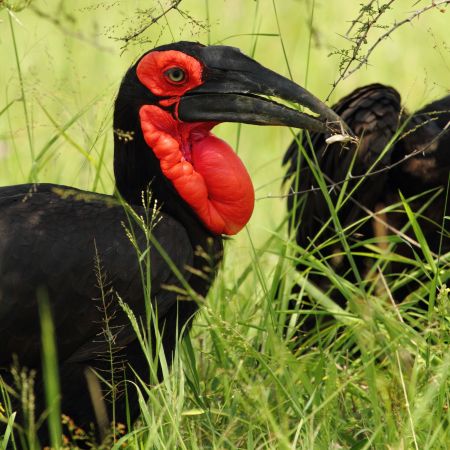 They are usually found in pairs or small family groups of between 3 and 7, and prefer open grasslands and savanna.
They will cover great distances in search of food, feeding on large insects and small vertebrates, and their large pick-like bill is particularly effective on snakes, tortoises and hares, or for digging up frogs buried up to 30cm beneath the surface.
An Adult or a Juvenile?
The distinctive red pouch around the throat area indicates that the bird is an adult. Younger ground hornbills have a yellow-grey colour pouch.
This pouch is primarily used for losing excess body heat when extended.
It also inflates slightly when calling - a deep booming noise usually uttered at sunrise and when communicating to other family members if they becomes separated while foraging for food.
Breeding Habits
The female, unlike other hornbills, does not get plastered into a nesting hole, but will lay 2 eggs at the base of a large tree or a rock crevice, and will remain on the eggs until they hatch.
During this incubation time, of about one month, the male will provide food for the female, and will take over the incubation should she briefly leave the nest.
After hatching, the young chicks will remain in the nest for 3 months, and are fed by both parents for a further 9 months after that.