

Nambia's busiest coastal resort town
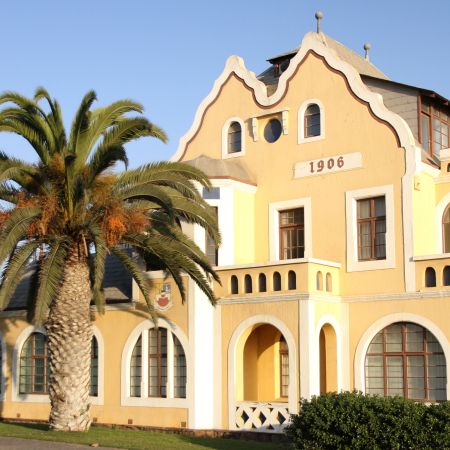 Surrounded on 3 sides by the Namib Desert, and on the 4th by the Atlantic Ocean, Swakopmund is Namibia's busiest resort town and offers a huge array of activities, an interesting German heritage, and some of the friendliest people in Southern Africa. The town is particularly busy during the Namibian school holiday periods in December and January, so anyone thinking of travelling to Swakopmund then should consider booking their accommodation well in advance.
Many of the locals are of German descent, and together with its beautifully preserved colonial architecture, the availability of German style beer, and the precise orderly manner which is evident everywhere, you would be forgiven for thinking you were in a small town in Germany and not on the edge of the Namib Desert. This effect is most pronounced if you are sitting in the excellent Swakopmund Brauhaus on a foggy or wet evening. Just look outside at the locals window shopping along the narrow street - and you would swear you are in Bavaria two weeks before Christmas!
There are a huge number of activities on offer around Swakopmund.
Quad-Biking
Probably the most popular single activity is quad-biking over the large red sand dunes that start from the edge of the town. For the novice, there are fully automatic bikes which are extremely easy to control and very stable, or if you are more of an expert you can opt for a manual bike with gears. Everyone is kitted out with crash helmets and goggles, and your guide leads you off into the desert.
Do not expect a geological history of the desert from your guide on these trips - quad-biking in Swakopmund is about adventure, not education! Groups can be as small as one or 2, and trips from one hour to one day are possible: however long you go for the trip will be great fun, and remember to take a camera as the scenery is spectacular.
Scenic Flights
Several operators offer scenic flights over the desert and coastline. The 2 most popular options both take about an hour and a half, and offer superb views.
The first option is to take a flight north up the coastline, over the Skeleton Coast and back round.
The second option is to fly across the desert to the Sossusvlei Dunes and back to Swakopmund along the coastline taking-in a number of shipwrecks.
A sunset or sunrise balloon ride is an alternative way to see the dunes from above.
In the Water
The vast expanses of beach are extremely popular with fishermen, although they not always the most inviting places for sun worshippers. Swimming is an option, remember that the ocean is the South Atlantic, so be prepared for it to be very cold!
 Sand-Boarding
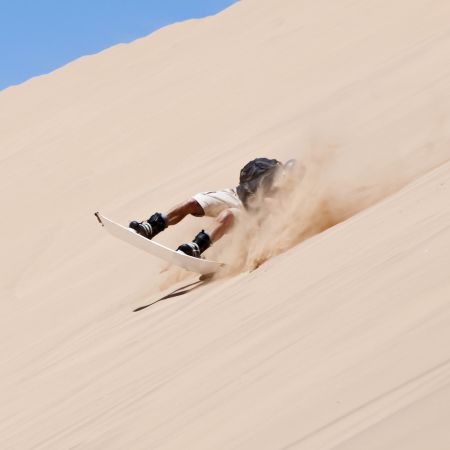
However, if you want to surf but don't want to brave the ocean try sand-boarding down the dunes instead. It's tough work climbing to the top of the dunes, but once you start off down the slope, the adrenalin rush is fantastic. Beginners can start by lying down flat on a board and surfing down that way - it's certainly much easier that way!
Cape Cross Seal Reserve
The Cape Cross Seal Reserve is a 125 km drive north of Swakopmund, and home to breeding colonies of thousands of Cape fur seals - as well as a rather awful smell! The Reserve is also where the first European, Diego Câo, set foot in Namibia in 1485, and erected a stone cross engraved with an inscription to King John II of Portugal. The cross was removed and taken to Germany in 1893, but a replica cross (with an additional German inscription added) was erected at the site. There is also a second cross which marks the exact spot where Câo's original cross once stood.
Dolphin and Seal Cruises
If you don't fancy the long drive, several operators offer half day dolphin and seal cruises from Walvis Bay, which is about 30 km from Swakopmund. The town itself lacks the character of Swakopmund, so the cruises are really the only reason to visit.
Weather
Being on the Atlantic coast, Swakopmund offers a cooling respite from the hotter temperatures of the inland hot desert, but this can have its disadvantages too. Occasionally, a thick grey fog will envelop the town, quickly transforming the sunny holiday resort into a dreary place where you only venture outside if totally necessary - so keep your fingers crossed that this happens when you are in a bar!