

Introduction
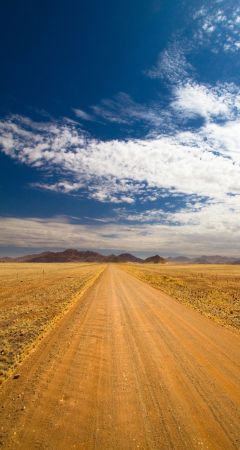
It is relatively easy to travel around Namibia by car, however, you need to be aware that the distances between destinations in this country are vast. In many cases, you may find that you do not pass a single person or car, let alone a town or village, for a couple of hours at a time.
 Namibians drive on the left, and all signposts are written in English. Seat belts must be worn at all times, and it is prohibited to use a mobile phone whilst driving. Traffic lights are referred to as 'robots', and the 4 way stop is certainly a traffic control to master quickly if you want to avoid having a collision at a stop junction.
It is advisable to carry your driving licence with you at all times, as this must be produced on request at the roadblocks which lead in and out of Windhoek. You may also be required to show any paperwork if you have brought your hire car over from neighbouring South Africa.
The general speed limit is a comfortable 120 km/h on the tar roads outside of towns and 100 km/h on gravel roads. In built up areas the speed limit is normally 60 km/h.
Road Conditions
A handful of major roads are tarred, well signposted, and relatively well maintained, so it is possible to cover long distances along them in relative comfort. However, the majority of roads in Namibia are gravel, and more often than not during your driving holiday you will find yourself on one for a long time. The gravel roads range from well maintained straight roads that can safely be travelled at 70-80 km/h (the official speed limit of 100 km/h on gravel roads is not advisable), to bumpy tracks that are difficult to distinguish from the rock-strewn landscape.
Your Hire Car
Although many visitors to Namibia choose to rent a 4WD vehicle, they find that they rarely need to engage 4WD and a regular 2WD vehicle is perfectly fine for the vast majority of journeys - even on gravel roads - although do take special care when driving round tight bends, as the gravel can cause the car to slide. Potholes should be avoided where possible, unless you want to change a tyre, or hand your car back with a bent tyre rim. A high-clearance 2WD is a good idea, especially in the rainy season when many gravel roads become flooded or crossed by seasonal rivers.
 Petrol
It is imperative to ensure that, before you set off on any trip, you have sufficient petrol in your tank. Even if you have ¾ of a tank, it is always worth filling up completely while you have the opportunity - it is not uncommon to find the nearest petrol station in the direction you are heading is a heartbreaking 400 km away! Investing in a non-plastic jerry can, and carrying an emergency supply of petrol - just enough to get you a further 100 km to the next petrol station - is strongly recommended, and also ensure that you have a good road map with petrol stations marked on it.
None of the petrol stations in Namibia are self-service, and generally credit cards are not accepted as a method of payment. Many of the larger petrol stations do have ATMs on site so that you can take cash out, but in the more remote places, ATMs may not be present (or the machine may be out of service), so you should always ensure that you have sufficient cash whenever you pull in to fill up with petrol.
When you pull into the petrol station, you will generally be waved to a free petrol pump by an enthusiastic attendant, complete with a beaming welcoming smile. Make sure that he waves you to the correct pump, however, and does not try to put petrol into your diesel car by mistake. It is customary to tip around N$5 once they have filled up your car, and funnily enough, you will often find that the total amount of petrol they put in the car means you will get enough loose change back for a tip!
Tyres
We would also recommend travelling with 2 spare tyres. Most 4WD vehicles come with a second spare tyre as a matter of course, and it is usually possible to hire a second spare tyre for other types of vehicle from your car hire company for a nominal charge.
Punctures are a common problem, especially on the gravel roads, and you may have to cover an extremely long distances before reaching the next town, where you can get the puncture fixed. The chances of getting a second puncture are quite high, and quite simply it is not worth the risk or worry of driving with no other form of emergency back up.
Most garages will repair a puncture for a small fee, and whilst they generally do a good job (lots of practice!), we recommend that you should still take the repaired tyre to your car hire company when you get the opportunity to get it professionally fixed or replaced.
 Border Crossings
If you are planning on crossing the border into South Africa or other neighbouring countries, then you need to inform your car hire company at the onset that this is what you intend to do. The hire company will issue you with an authorisation letter which should include the registration number and the chassis number. There is usually no additional charge to do this paperwork. All you then have to do is present this letter at the border post, and you are OK to drive out of Namibia.
At the end of your holiday, should you wish to leave your hire car for example in South Africa if you are flying home from either Cape Town or Johannesburg, then this is normally possible, however, an additional (and hefty) one-way international drop off charge will be applied to the car hire rate.
Safety Precautions
When driving anywhere in Namibia, try to apply the following safety precautions:
-
Always drive with your doors locked and windows wound up, especially when stopped at traffic lights.
-
Don't ever stop to pick up hitchhikers, however innocent, lost or appealing they look. If you are worried about someone's plight, stop at the next town and report it to someone there.
-
Do not leave anything valuable on show in your car when you leave it unattended, and ALWAYS lock your car when you leave it, even if you are only going to be gone for a few minutes.
-
Try to always park in a busy, well-lit area.
-
Don't get out of your car if you are knocked or hit from behind in suspicious circumstances.
-
Take advice from your hosts where you are staying, and ask if there are any areas that tourists should avoid driving through.